1What is a hotel card machine and how does it function within hotel payment operations?
A hotel card machine is a payment terminal used at the front desk to process in-person guest payments by chip, swipe, tap, or mobile wallet. In modern hotel operations, the device typically connects to the property management system (PMS) so that payments automatically post to the correct reservation or guest folio. This integration reduces manual entry, prevents posting errors, and helps hotel staff track balances, invoices, and receipts while maintaining consistent financial records across the guest journey from check-in to check-out.
2How does an integrated hotel card machine differ from a standalone payment terminal?
An integrated hotel card machine communicates directly with hotel software such as a PMS or booking engine, allowing transaction amounts to be sent automatically from the guest folio to the payment terminal. A standalone terminal processes payments independently and requires staff to manually enter charges and reconcile them later. Integration reduces administrative work, improves accuracy in financial reporting, and ensures payments are linked to the correct reservation, which is essential for efficient hotel accounting and operational transparency.
3Why is connecting front-desk payments to a PMS important for hotel operations?
Connecting front-desk payments to a property management system ensures every payment automatically updates the correct reservation and guest account. This connection improves operational efficiency by eliminating manual posting, reducing accounting discrepancies, and simplifying end-of-day reconciliation. Hotels benefit from better visibility over payments collected through direct bookings, OTA reservations, and on-property purchases. For U.S. operators managing multiple payment sources, PMS integration helps ensure financial accuracy, faster guest service, and clearer operational reporting across departments.
4What payment methods should a hotel card machine support in the U.S. hospitality market?
A hotel card machine in the U.S. should support EMV chip cards, magnetic stripe fallback, contactless tap payments, and major mobile wallets such as Apple Pay and Google Pay. Guests increasingly expect flexible payment options, especially during fast check-in or check-out processes. Supporting these methods improves convenience and reduces friction at the front desk. Hotels also benefit operationally by accommodating both credit and debit cards while aligning with current payment security standards used throughout the U.S. travel and hospitality industry.
5How do front-desk card payments connect with a hotel booking engine and online reservations?
Front-desk card payments handle in-person charges such as outstanding balances, extras, or incidentals, while a booking engine processes online reservations and deposits before arrival. When these payment flows are connected through hotel software, staff can immediately see which bookings are prepaid, partially paid, or awaiting settlement. This alignment reduces duplicate charges and simplifies guest billing. Integrating payment systems across booking engine transactions and on-property payments ensures consistent financial records throughout the entire reservation lifecycle.
6How do OTA bookings influence payment processing at a hotel property?
Online travel agency bookings often introduce different payment structures, such as hotel-collect reservations, OTA-collected payments, or virtual card settlements. Hotels must clearly identify which transactions they are responsible for collecting at the property. Integrated hotel software helps front-desk teams recognize these differences instantly, preventing incorrect charges or missed payments. For U.S. properties working with multiple OTA channels, accurate payment handling ensures smoother check-ins, better financial reconciliation, and fewer disputes related to guest billing.
7What is a virtual credit card and how is it used in hotel payments?
A virtual credit card is a temporary digital card number issued for a specific transaction or reservation. In hospitality, online travel agencies often use virtual cards to pay hotels for prepaid bookings. The card becomes active on a designated date and can only be charged for a defined amount. This system improves payment security and simplifies settlement between distribution channels and hotels. Front-desk teams must understand virtual card rules to ensure payments are processed correctly and reconciled with reservations.
8How can a connected card machine improve the guest check-in and check-out experience?
A connected payment terminal improves the guest experience by allowing hotel staff to send payment amounts directly from the reservation to the card machine. Guests simply approve the transaction, reducing waiting time at the desk and eliminating manual entry errors. Faster transactions support smoother check-in and check-out flows, especially during peak departure periods. For hotels focused on operational efficiency and service quality, integrated payment technology helps deliver a more streamlined and professional guest interaction.
9What operational problems can automation solve in hotel payment workflows?
Automated payment workflows reduce manual data entry, accounting discrepancies, and delays in posting transactions to guest folios. Without automation, front-desk staff may need to enter payment amounts in multiple systems, increasing the risk of mismatched records. Automation ensures that payments, refunds, and balances automatically update across the PMS and financial reporting tools. This helps hotels maintain accurate records, improve staff productivity, and reduce the time spent resolving billing issues during daily operations.
10How should hotels evaluate the true cost of a card machine and payment processing?
The cost of a hotel card machine involves more than transaction fees. Hotels should consider hardware costs, payment processing rates, integration capabilities, reconciliation workload, and potential chargeback exposure. Operational efficiency also affects total cost because manual reconciliation and accounting corrections require staff time. Evaluating the complete payment workflow—including integration with PMS, booking engine, and accounting systems—helps hotels determine the true financial impact of a payment solution beyond basic processing rates.
11What steps are involved in implementing a hotel card machine in a property’s technology stack?
Implementing a hotel card machine typically involves configuring payment accounts, connecting the terminal to hotel software, testing payment workflows, and training staff on operational procedures. Hotels must ensure transactions correctly post to guest folios and appear in financial reporting systems. Reliable network connectivity and secure device management are also essential. Proper implementation ensures front-desk payments align with reservations, accounting processes, and operational workflows from the first day of use.
12How much training do hotel staff usually need to operate an integrated card machine?
Staff training requirements are generally modest when the payment terminal integrates directly with hotel software. Employees mainly learn how to initiate charges from the reservation, process refunds, confirm payments, and review transaction status. Because the payment amount originates from the PMS or guest folio, staff avoid manually entering totals. This simplified workflow allows new employees to learn the system quickly while maintaining accurate payment handling during busy front-desk operations.
13What security and compliance requirements apply to hotel card payments in the United States?
Hotel payment systems in the United States must comply with PCI DSS standards, which govern how cardholder data is stored, processed, and transmitted. Compliance requires secure hardware, controlled access to payment systems, and operational procedures that protect sensitive information. Hotels must also maintain secure networks and ensure vendors handling payment data follow proper security protocols. Adhering to these standards reduces the risk of data breaches and supports safe financial transactions within hospitality operations.
14How do chargebacks and payment disputes affect hotel operations?
Chargebacks occur when a cardholder disputes a transaction with their bank, often due to unclear billing, unauthorized charges, or misunderstanding of fees. For hotels, disputes create administrative work and may lead to lost revenue if documentation is insufficient. Payment systems that link transactions directly to reservations and invoices help staff provide clear evidence during dispute resolution. Accurate records and transparent billing practices significantly reduce the likelihood of chargebacks in hospitality environments.
15What regulatory considerations influence hotel payment practices in the U.S. market?
U.S. regulations increasingly require transparency in pricing and payment disclosures within hospitality transactions. Hotels must ensure guests clearly understand total charges, including mandatory fees, before completing a booking. Payment systems should support consistent price presentation from reservation through checkout. Transparent billing helps hotels comply with regulatory expectations while also improving guest trust and reducing disputes related to unclear charges or unexpected fees.
16How can hotel payment systems support ancillary revenue and upselling?
Hotel payment systems help capture revenue from extras such as parking, breakfast, upgrades, late check-out, or minibar purchases. When these charges are linked to the reservation and processed through the payment terminal, they automatically update the guest folio and financial reports. This integration ensures ancillary revenue is accurately recorded and reduces the risk of missed charges. Efficient payment collection also supports revenue management strategies focused on maximizing total guest spend.
17How do integrated payment terminals simplify accounting and reconciliation?
Integrated payment terminals automatically synchronize approved transactions with reservation data and financial reporting tools. This synchronization eliminates the need to match terminal receipts with folio entries manually. Accounting teams gain clearer transaction records, simplified reconciliation processes, and more accurate financial reporting. Hotels operating multiple booking channels benefit particularly from integrated reporting because it consolidates payments from direct bookings, OTA reservations, and on-site purchases.
18What questions should independent hotels ask before choosing a payment solution?
Independent hotels should evaluate whether a payment solution integrates with their PMS, booking engine, and channel manager. They should also review transaction fees, refund capabilities, reporting tools, security compliance, and staff usability. Understanding how payments flow from reservations to accounting systems is critical. Choosing a solution that fits operational workflows reduces administrative workload and helps hotels maintain accurate financial management as booking volume and distribution channels grow.
19Why is cloud-based hotel software important for managing payments across teams?
Cloud-based hotel software allows staff, managers, and finance teams to access the same reservation and payment information from any authorized location. This shared visibility improves collaboration and ensures everyone works from consistent financial data. Cloud platforms also support automatic updates and centralized reporting, which helps hotels maintain operational efficiency. For properties with multiple shifts or distributed teams, cloud systems provide reliable access to payment and reservation information in real time.
20How do hotel payment systems interact with channel managers and distribution platforms?
Channel managers distribute rates and availability to online travel agencies, while payment systems handle financial transactions related to those bookings. When payment tools integrate with channel distribution and PMS platforms, hotels can track which bookings are prepaid, OTA-collected, or payable at the property. This visibility simplifies financial reconciliation and helps hotels maintain accurate payment records across all booking channels, improving operational clarity and reducing administrative complexity.
21When should a hotel upgrade from manual payment processing to an integrated system?
Hotels often upgrade when manual payment processes create frequent errors, reconciliation delays, or confusion about reservation balances. Properties managing increasing booking volume, multiple distribution channels, or higher ancillary revenue typically benefit from integrated payment workflows. An integrated system connects payments directly to reservations and financial reports, allowing staff to process transactions faster while reducing administrative workload and improving operational consistency.
22What key payment metrics should hotels monitor to evaluate financial performance?
Hotels should track payment method distribution, settlement timing, refund frequency, chargeback rates, and outstanding guest balances. Monitoring these metrics helps identify operational inefficiencies and revenue risks. Payment analytics also reveal how bookings from different channels affect cash flow and reconciliation workload. By reviewing these indicators regularly, hotel managers gain insight into financial performance and can refine operational processes that influence payment efficiency.
23How do contactless and mobile wallet payments affect hotel operations?
Contactless and mobile wallet payments speed up front-desk transactions and provide guests with familiar payment options. Faster processing reduces wait times during busy arrival or departure periods. Mobile wallets also support secure tokenized payments, which help protect card information. Hotels that support modern payment technologies align with evolving guest expectations while maintaining efficient payment workflows and secure financial transactions.
24What common mistakes do hotels make when managing card payment technology?
Hotels sometimes rely on disconnected payment systems that require manual reconciliation between the terminal, PMS, and accounting tools. Other common mistakes include insufficient staff training, unclear refund procedures, and weak documentation for disputed charges. Ignoring integration between payment tools and hotel software can also lead to inconsistent financial records. Addressing these operational gaps helps hotels maintain reliable payment workflows and reduce administrative inefficiencies.
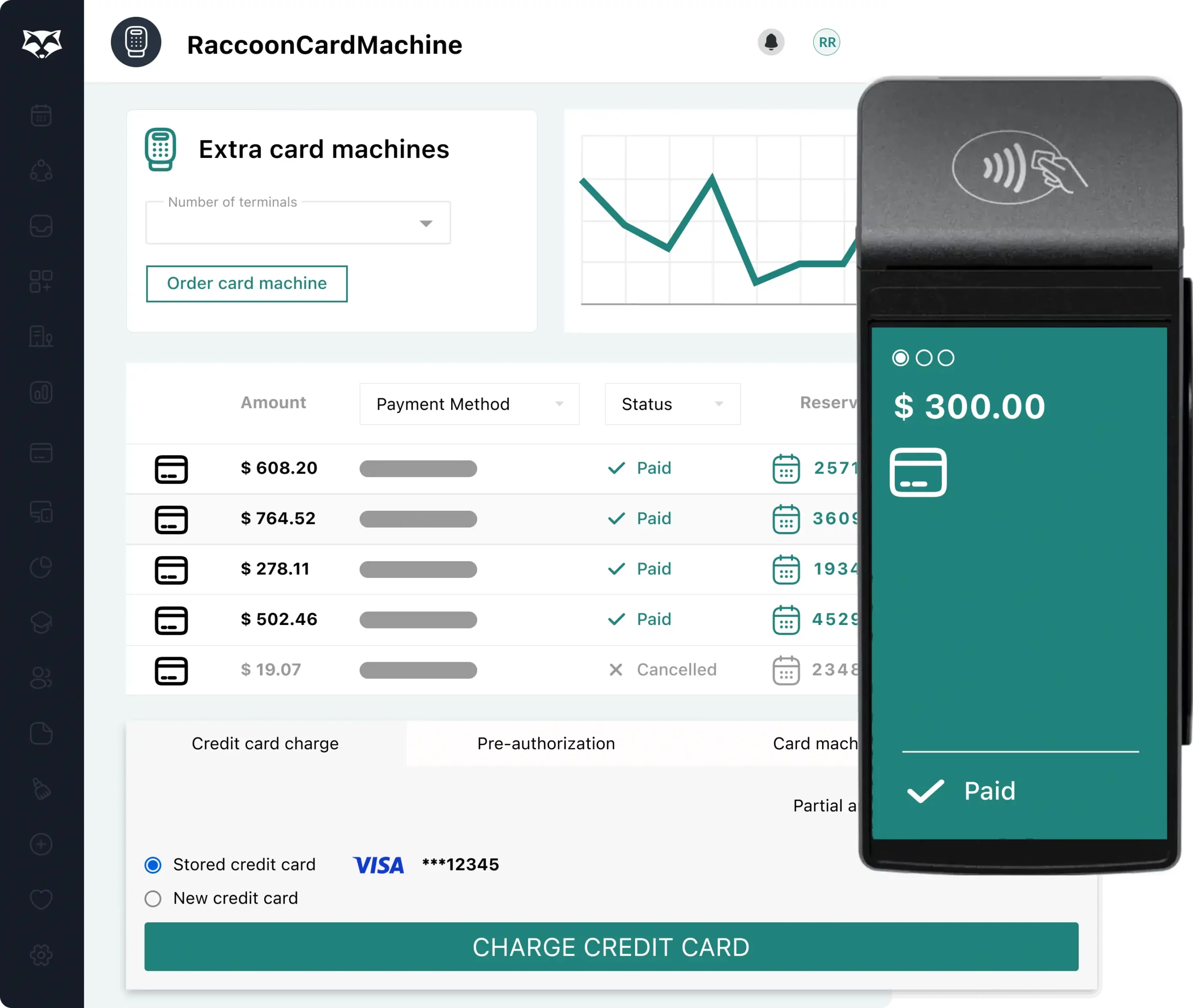
25How does RoomRaccoon position its card machine within a hotel software platform?
RoomRaccoon positions its card machine as part of an integrated hotel management platform that connects payments with reservation data and operational workflows. Within the RoomRaccoon environment, the card machine links directly to the property management system, booking engine, and channel manager so transactions automatically update guest folios and financial records. This unified approach helps hotels manage reservations, payments, and reporting within one cloud-based system while maintaining operational visibility and financial accuracy.